

Rug Cleaning vs. Carpet Cleaning: Why Your Cleaner's Background Actually Matters
March 23rd, 2026
Patrick Santoro Jr.
Co-Owner of Around The Clock
Here’s a question most people never think to ask when they call a cleaning company: Did the person who shows up actually train for this specific thing or are they a carpet cleaner who also does rugs?
It sounds like a small distinction. It isn’t. The difference between a rug specialist and a carpet cleaner applying their trade to your rug is the difference between a rug that comes back looking restored and a rug that comes back damaged, discolored, or smelling worse than when it left.
At Around The Clock Rug Washing & Specialty Cleaning, we built our entire facility around this distinction. Here’s why it matters so much.
A Rug and a Carpet Are Not the Same Thing
This is the foundational truth that the cleaning industry doesn’t talk about enough and that most consumers don’t realize until something goes wrong.
Wall-to-wall carpet is manufactured for a single purpose: to cover floors. It’s typically made from synthetic fibers — nylon, polyester, or olefin — tufted into a backing material and designed to handle foot traffic, vacuums, and periodic steam extraction. It’s practical. It’s replaceable. And it responds reasonably well to in-home hot water extraction.
An area rug is something else entirely.
Whether it’s a hand-knotted Persian passed down through your family, a machine-woven wool piece from Belgium, a silk Chinese rug, or a natural fiber jute rug from a living room in Garden City, it was constructed with specific fibers, specific dyes, and a specific structure that reacts to water, heat, and cleaning agents in ways a carpet technician may have never been trained to anticipate.
Rugs are textile art. Carpets are floor covering. Treating them the same way is where damage begins.
What a Carpet Cleaner Is Trained to Do
A standard carpet cleaning technician is trained to operate hot water extraction equipment (commonly called steam cleaning). They arrive at your home with a truck-mounted unit, run a pressurized wand across the surface of your carpet, and extract water along with whatever loosens from the top layer of fibers.
For synthetic wall-to-wall carpet, this works reasonably well.
For an area rug, it creates a set of problems most people don’t discover until it’s too late:
- Dye bleeding — Many area rugs, particularly Oriental and Persian rugs, are dyed with natural or semi-synthetic dyes that bleed when exposed to the wrong water temperature, pH levels, or cleaning solutions. A carpet technician using standard solutions may not test for dye stability before applying product. The result can be color bleeding that permanently alters the rug’s appearance. At Around The Clock, we test for color fastness and use formulated solutions to prevent bleeding. We also offer color correction services.
- Fiber damage — Wool, silk, and natural fiber rugs react very differently to heat and moisture than synthetics do. Wool can shrink. Silk can lose its sheen and structural integrity. A technician trained primarily on synthetic carpet may apply the same process without adjusting for fiber type.
- Foundation saturation — When a rug is cleaned in-home, water and cleaning solution soak into the backing and foundation. Without proper extraction and controlled drying, that moisture stays trapped — creating the conditions for mold, mildew, and odor that can be worse than what the cleaning was meant to fix.
- Surface-only cleaning — Hot water extraction reaches approximately the top 30% of a rug’s fiber depth. The dry soil, grit, pet dander, and debris that have settled into the base of the rug — the part that acts like sandpaper on the fibers from the inside — doesn’t get touched.
None of this means carpet cleaners are bad at their jobs. It means their job is carpet. And your rug isn’t carpet.
What a Rug Specialist Is Trained to Do Differently
A technician trained specifically in area rug care approaches the same job from a completely different foundation. Before a single drop of water is applied, a rug specialist runs through a pre-inspection that covers:
- Fiber identification — What is this rug made of? Wool, silk, cotton, jute, synthetic, or a blend? Each fiber type has specific protocols.
- Dye stability testing — How do the dyes in this rug react to water and cleaning agents? Are any areas at risk of bleeding or fading?
- Construction assessment — Is this rug hand-knotted, hand-tufted, machine-woven, or flat-woven? The construction determines how much moisture the rug can safely handle and how it needs to be dried.
- Existing damage documentation — Are there pre-existing stains, fringe damage, or structural issues that need to be noted before cleaning begins so the customer knows they existed prior to the process?
This isn’t extra caution. This is standard protocol for anyone who has been properly trained in rug care. It’s the difference between a technician who knows what they’re holding and one who is guessing.
At Around The Clock Rug Washing & Specialty Cleaning, every rug that comes through our Farmingdale facility goes through this pre-inspection before anything else happens. It’s step one of our process — not an optional add-on.
Why the Location of Cleaning Matters as Much as the Technique
Even with the right training, a technician cleaning a rug in your living room is working with a fundamental limitation: they cannot fully control the environment.
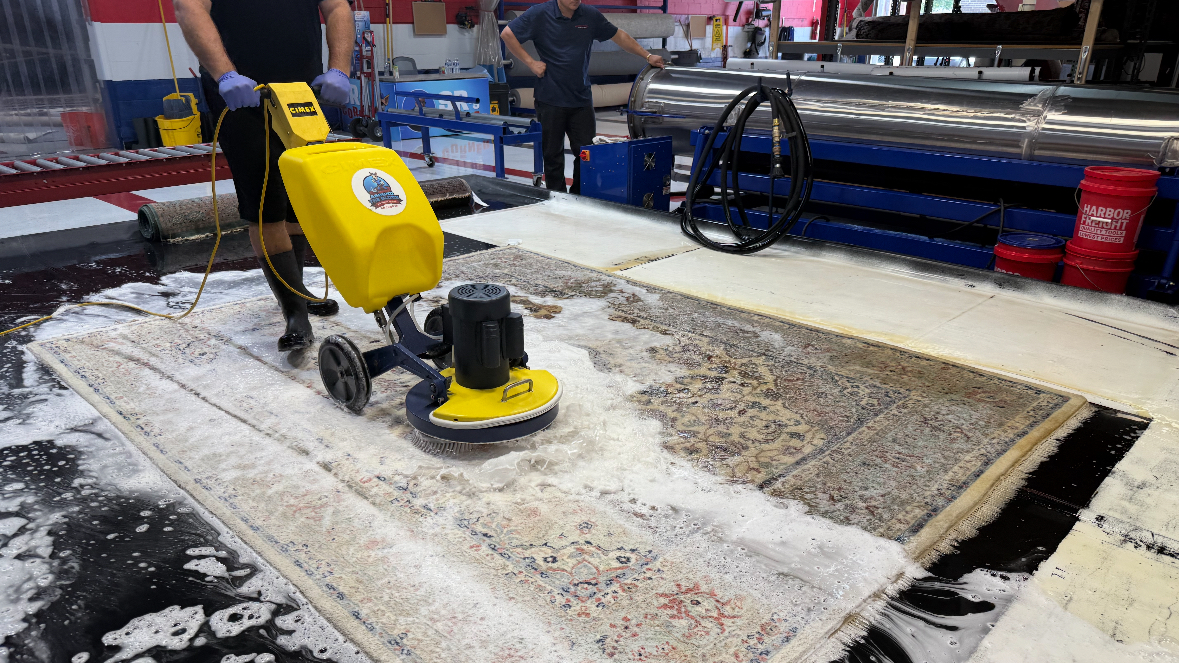
Proper rug washing requires full submersion — the rug needs to be saturated on both the face and the foundation, worked through with fiber-appropriate solutions, rinsed completely, and then dried in a controlled environment where temperature, airflow, and humidity can be managed. That process cannot happen on your floor.
This is why Around The Clock Rug Washing built a dedicated facility. When your rug comes to us in Farmingdale, it goes through a complete in-plant process:
- Pre-inspection — fiber type, dye stability, existing damage
- Dry soil removal — mechanical dusting to vibrate out the grit and debris embedded at the base of the fibers before any moisture is introduced
- Full submersion washing — front and back, with fiber-specific cleaning agents
- Centrifuge extraction — removing 95% of moisture in minutes, eliminating the slow-drying conditions that cause mildew and odor
- Climate-controlled drying and finishing — grooming the fibers back to their natural direction and inspecting the result before the rug leaves our facility
Every step requires space, equipment, and expertise that simply doesn’t exist in an in-home service call. It’s not a criticism of carpet cleaners — it’s a structural reality of what proper rug washing actually demands.
How to Know Which One You Actually Need
Not every rug requires a full facility wash every time — and not every cleaning situation calls for the same approach. Here’s a straightforward way to think about it:
A carpet cleaner may be appropriate if:
You have synthetic wall-to-wall carpet that needs periodic refreshing
You need a quick surface clean between professional washes
A rug specialist is what you need if:
You have a wool, silk, cotton, or natural fiber rug
Your rug is hand-knotted, hand-tufted, or an antique
Your rug has pet urine, deep odor, or embedded soil at the foundation
You have a Persian, Oriental, or any high-value specialty rug
You’ve had your rug “cleaned” before and it still doesn’t look or smell right
If you’re unsure which category your rug falls into, the answer is almost always a specialist. A rug specialist can assess a machine-made synthetic and tell you honestly what it needs. A carpet cleaner may not recognize the risks involved in cleaning a hand-knotted wool piece the same way.
Why Around The Clock Built a Facility Instead of Going In-Home
When we made the decision to build a dedicated rug washing facility in Farmingdale rather than offer only in-home cleaning services, it wasn’t a complicated choice. We looked at what the Long Island market had, we looked at what rugs actually need, and we built the gap.
There were very few in our market doing rug cleaning properly — with a real facility, real equipment, and real training in the difference between a rug and a carpet. Around The Clock Rug Washing & Specialty Cleaning is ARCS registered, meaning we are verified members of the Association of Rug Care Specialists — an international organization that requires 95% of all cleaning to be performed at the member’s own in-plant facility. Our technicians are also IICRC certified in water damage restoration.
We didn’t get those credentials by accident. We built a business specifically designed to earn them.
The Question Worth Asking Before You Book Anyone
The next time you’re looking for a rug cleaner on Long Island, ask two simple questions:
- Do you have your own cleaning facility, or do you clean in-home?
- Are you ARCS registered?
Around The Clock Rug Washing & Specialty Cleaning is in Farmingdale. We serve all of Long Island. We have our own facility. We are ARCS registered. And we have been in the cleaning business, in one form or another, since 1978.
If you want your rug cleaned by someone who actually trained for it, you know where to find us.
54 Sarah Drive, Farmingdale, NY
