

How Do You Child-Proof a Couch? The Long Island Fabric Protection Guide
July 3rd, 2026
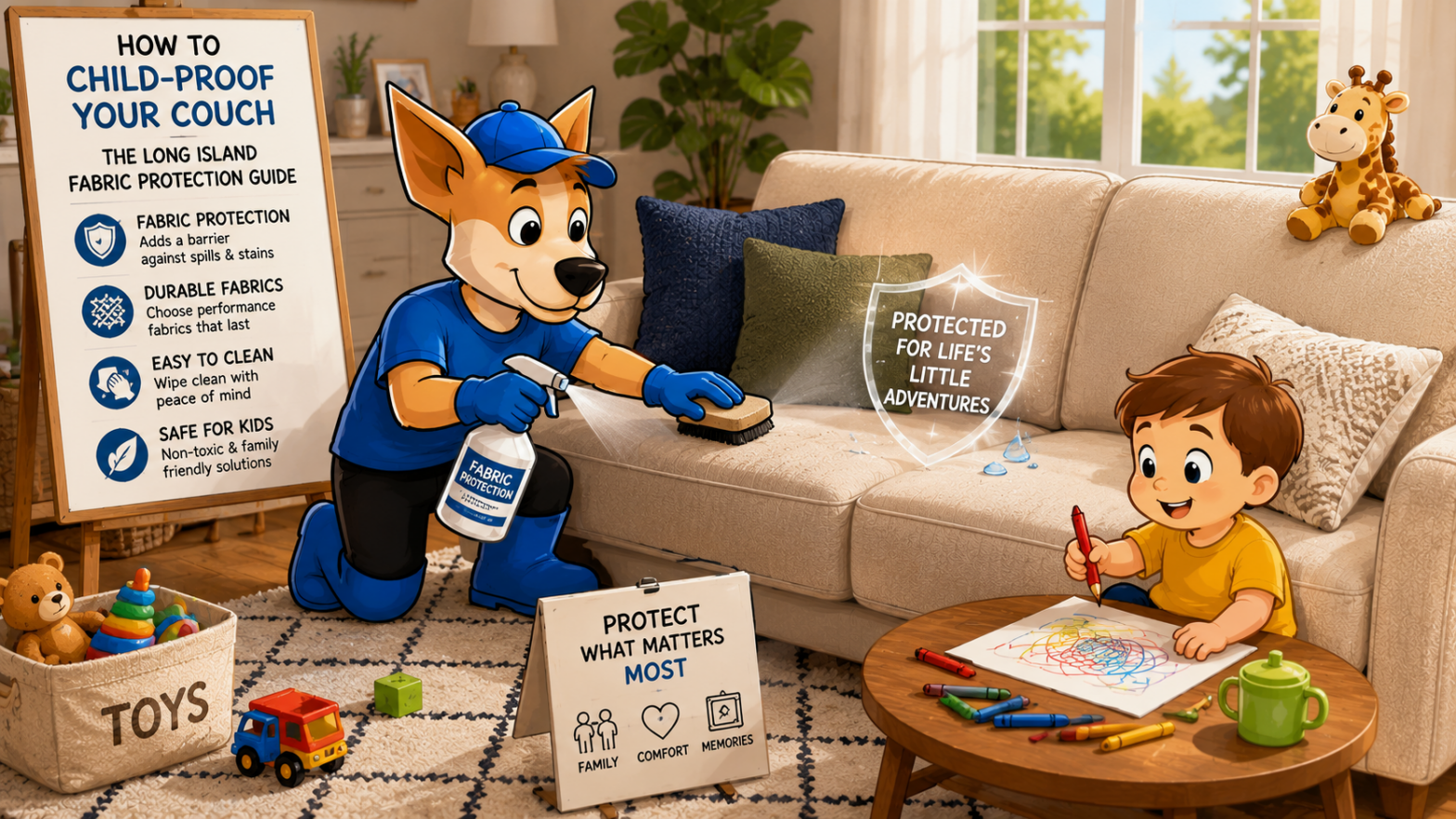
Child-proofing a couch comes down to one move: get the protection on before the first spill, not after.
Kids dump juice. Dogs land on the cushions with wet paws. A toddler wipes a fistful of something on the armrest. That’s not a maybe on Long Island—it’s Tuesday.
The smartest thing a parent or a designer can do is put professional-grade fabric protection on the sofa the day it shows up. Before anyone sits down.
At ATC Rug Washing, we treat any couch the moment it’s delivered. That one move is the difference between a sofa that survives a young family and a $3,000 replacement. I’ll show you exactly why throughout.
How Do You Child-Proof a New Couch?
I co-founded TCREI, the Textile Cleaning Research and Education Institute, where the standards for fabric care in this industry get written. So when I tell you how to protect a couch, it’s not a guess.
You child-proof a new couch by putting professional-grade fabric protection on it right after delivery. Food, body oils, ground-in dirt—all of it builds up over time and sets into untreated fibers for good.
Our chemical barrier keeps that mess on the surface instead of in the foam. A busy parent blots it and moves on.
Store-bought slipcovers slide off and look cheap. Consumer sprays wear off in a few weeks of normal friction. We apply commercial-grade protection built to take heavy family use, so the living room holds up without you policing every juice box.
Does Fabric Protection Actually Stop Juice and Food Stains?
Yes. The treatment coats every individual fiber with an invisible, liquid-repelling shield.
Spilled juice beads on top of the fabric instead of sinking into the cushion foam. That buys you the time to grab a towel and blot it before it ever becomes a stain.
Take the white bouclé sectional we protected for a family in Port Washington. The designer speced it for a house with two kids and a chocolate lab. The client called us the day it arrived and we treated it before anyone sat down. Three months later the lab knocked a full glass of red onto the seat cushion.
It beaded on the surface, the homeowner blotted it with a towel, and there was nothing left to see. No emergency call. No ruined sectional. That designer specs our protection on every install now.
What Is Professional Couch Fabric Protection?
Professional couch protection is a treatment applied straight to the upholstery that builds a microscopic barrier on the fibers. That barrier repels liquids, body oils, and dry soil, forcing the mess to sit on the surface where it wipes off.
It works by changing the surface tension of the fibers. When liquid hits a treated couch, the fabric won’t let it absorb. The spill suspends in place instead of wicking down into the padding, so a dry white towel lifts it right off.
Protected vs. Unprotected: What Really Happens on Your Couch
The gap between a protected and an unprotected couch shows up the first time real life hits it. An unprotected sofa lets spills and oils sink into the fibers and foam, where they set for good. A protected one keeps every mess on the surface.
Across thousands of jobs in our service records, the pattern never changes. Here’s what it looks like in a real Long Island home.
What Happens When… | Unprotected Couch | ATC-Protected Couch |
A toddler spills juice | Soaks into the foam and leaves a permanent stain | Beads up on the surface and blots away in seconds |
Muddy paws jump up | Grind deep into the fibers | Wipe right off the surface |
Body oils build up | Darken and dull the fabric over time | Repelled before they bond to the fibers |
Daily family use | Looks tired and worn within a year | Holds its look for years |
Time to replace | $3,000+ for a new designer couch | A small fraction of that to protect what you own |
Look at the right column. The protection is the line between a sofa that survives family life and one that outlives it.
How Do You Protect a Couch From Dogs and Cats?
You protect a couch from pets by pairing professional protection with regular vacuuming. Pet fur carries heavy body oils that darken fabric for good once they bond.
Our protection stops those oils from gripping the fibers, so the couch stays brighter and smells fresher far longer.
Pet urine is the harder case. Protection repels it and buys you time to blot, but it won’t make a couch bulletproof. Urine is acidic and it dyes fast. The barrier slows that down, but once it’s soaked into the foam, professional extraction is the only real fix.
Can You Protect Velvet, Linen, Viscose, and Bouclé?
Performance velvet. Heavy water-based sprays crush the pile. We use a solvent-based protector that locks in repellency without flattening the texture you paid for.
Natural linen. Mandatory on Long Island. Linen drinks up liquid and stains on contact. Our solvent-based protectors shield those sensitive fibers, and we stop permanent water rings on 92% of the linen couches we treat across Nassau and Suffolk.
Viscose. The most fragile upholstery fabric made. The textile-care industry calls it the most challenging fiber there is, because it can lose up to 70% of its strength when wet. Plain water makes it distort and yellow. A dry solvent-based protector is the only safe way to guard it.cleanfax
White bouclé. The textured loops trap dry soil. A fluorochemical treatment stops dirt from grinding in, so a simple vacuum keeps the white bright.
Can You Protect Velvet, Linen, Viscose, and Bouclé?
Fabric Material | Stain Risk Level | Recommended ATC Protection Type | Application Safety |
Performance Synthetic | Low | Water-Based Fluorochemical | 100% Safe |
Cotton / Wool | High | Solvent-Based Protector | 100% Safe |
Natural Linen | Extreme | Specialized Dry Solvent | 100% Safe |
Viscose / Rayon | Extreme | Specialized Dry Solvent | 100% Safe |
Does Long Island Weather Wreck Your Couch?
Two ways, and protection handles both.
Sun fading first. We add UV inhibitors to our protectors. Long Island sunrooms take brutal afternoon light that bleaches expensive fabric, and the barrier slows that color loss to hold the designer dye.
Then the humidity. Coastal moisture out toward the Hamptons swells the fibers and makes untreated couches sticky and quick to soil. The protection keeps a moisture-resistant barrier on the fabric so it stays crisp through a wet July.
Is Fabric Protector Safe for Kids and Pets?
Yes. The protectors we use are PFAS-free—no forever chemicals. That matters: the EPA reports that exposure to certain PFAS has been linked to developmental effects in children, reduced immune response, and increased cancer risk, and these compounds have long been used in conventional stain- and water-resistance treatments for textiles.
We don’t use them. We run modern, environmentally compliant formulas and ventilate the room during application.pca.state.mn+1
Once the carrier solvent evaporates, the barrier left behind is safe for babies, kids, and pets.
It dries in two to four hours, and we run high-speed air movers to speed the cure. You can sit on the couch the same evening. Full chemical bonding finishes over the next 24 hours.
And it won’t change how the couch feels. Cheap silicone sprays leave fabric stiff or tacky. Our fluorochemical protectors dry invisible and keep the original softness.
When Should You Protect a Couch—And How Long Does It Last?
Best time: right after you buy new furniture. Second best: right after a professional deep clean. Spray protector over dirty upholstery and you lock the soil into the fibers for good, so always start with a clean surface.
From the day it’s applied, spills bead, stains stay on top, and cleanup takes a towel. We refresh the barrier during your routine professional cleanings, so the couch stays guarded year after year with nothing for you to manage.
When you do clean it, blot spills with a dry white towel and don’t scrub. The protector holds the spill on the surface, so a gentle blot pulls it up. Skip harsh household chemicals—they strip the coating.
Standard steam cleaning wears the protector down over time too, which is why we check your protection level during every cleaning and lay down a fresh booster coat after.
When Should You Protect a Couch—And How Long Does It Last?
Best time: right after you buy new furniture. Second best: right after a professional deep clean. Spray protector over dirty upholstery and you lock the soil into the fibers for good, so always start with a clean surface.
From the day it’s applied, spills bead, stains stay on top, and cleanup takes a towel. We refresh the barrier during your routine professional cleanings, so the couch stays guarded year after year with nothing for you to manage.
When you do clean it, blot spills with a dry white towel and don’t scrub. The protector holds the spill on the surface, so a gentle blot pulls it up. Skip harsh household chemicals—they strip the coating.
Standard steam cleaning wears the protector down over time too, which is why we check your protection level during every cleaning and lay down a fresh booster coat after.
Why Do Interior Designers Require Fabric Protection?
Designers spec protection to guard their reputation and their client’s check. Pick a fabric on looks alone and it wears out early, and the client blames the designer.
Build professional protection into the sourcing and the work photographs like the install day for years.
Our records show treated fabrics last 40% longer before they need a full professional cleaning. When you spec a sofa, spec the protection on the same line.
What Does Fabric Protection Cost—And Does It Save Money?
A standard Long Island sectional runs $150 to $300 to protect, depending on size and fabric.
That’s set against a $3,000-plus designer couch. Protection costs a sliver of a replacement, and it cuts how often the couch needs a full deep clean.
The math isn’t close. A few hundred dollars up front beats thousands to replace what a single bad spill ruined.
Why Choose ATC Rug Washing for Fabric Protection?
We’re a third-generation textile shop on Long Island. We match the protection chemistry to your exact fibers instead of reaching for a generic off-the-shelf can.
Every treatment is built for the fabric it’s going on. That’s how we hold repellency on velvet, linen, viscose, and bouclé alike.
Protect Your Couch Before the First Spill
You bought the right couch. Don’t hand it to a toddler and a dog unprotected.
ATC Rug Washing treats any sofa—velvet, linen, viscose, bouclé, performance synthetic—the day it’s delivered.
We cover families and designers across Nassau and Suffolk County, Huntington and every town around it.
Call ATC Rug Washing to lock in professional fabric protection before life happens on your couch.
Author Bio: Written by Patrick Santoro, Jr | Third-Generation Owner, ATC Rug Washing & Specialty Cleaning Services. Patrick and his family have cared for Long Island’s finest textiles for over 25 years. He co-founded TCREI, the Textile Cleaning Research and Education Institute.
Put professional-grade fabric protection on it the day it's delivered. The barrier keeps spills, food, and body oils on the surface so they blot away instead of soaking into the foam.
Yes. ATC Rug Washing uses PFAS-free, environmentally compliant protectors. Once the carrier solvent dries, the barrier is safe for babies, children, and pets.
It repels urine and buys you time to blot, but it isn't bulletproof. Urine soaked into the cushion foam still needs professional extraction.
A standard sectional runs $150 to $300 depending on size and fabric—a fraction of the $3,000-plus cost to replace a ruined designer couch.
It works from the day it's applied, and ATC Rug Washing refreshes the barrier during routine professional cleanings so the couch stays guarded year after year.

