Around The Clock

Pet Urine Rug Cleaning on Long Island: Why the Odor Keeps Coming Back

July  27th, 2026
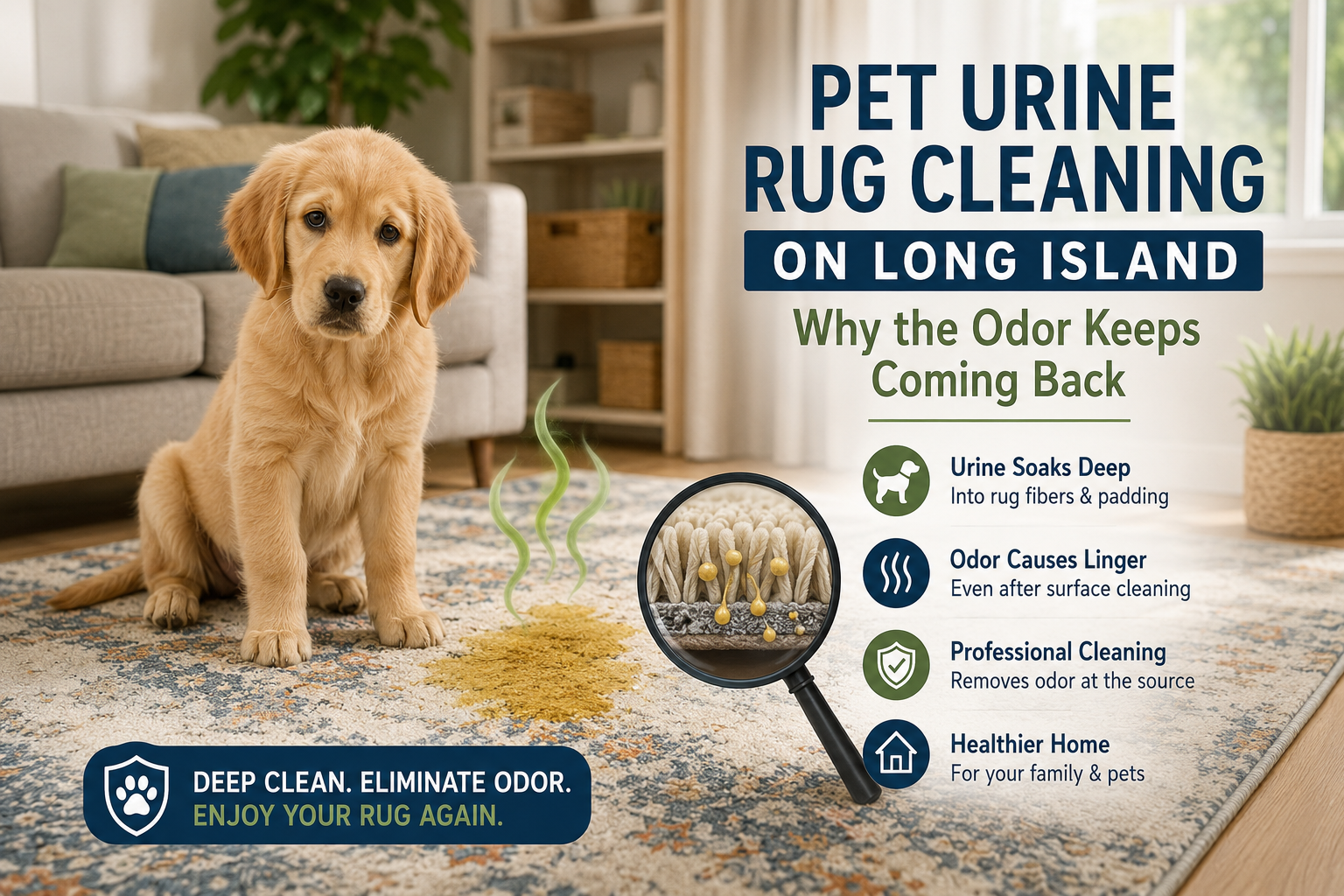
Golden Retriever puppy sitting on an area rug in a Long Island home with an infographic explaining why pet urine odors return and how professional rug cleaning removes odors from deep within the rug fibers and padding.
Pet urine can travel through a rug’s pile, enter its foundation, spread across the back, and reach the padding or flooring underneath. Treating only the visible spot may improve the smell temporarily while leaving most of the contamination behind.

Professional pet urine rug cleaning on Long Island should address the source of the odor throughout the rug. When the rug’s construction and condition allow, this requires inspection, dry-soil removal, decontamination treatment, complete washing, thorough rinsing, water extraction, and controlled drying.

At Around The Clock (ATC) Rug Washing, pet-contaminated rugs are cleaned inside our dedicated Farmingdale facility. We evaluate each rug before selecting a treatment because wool, silk, cotton, viscose, synthetic fibers, handmade construction, unstable dyes, and existing damage require different handling.

Quick Answer: How Is Pet Urine Removed From a Rug?

Professional pet urine removal involves locating the affected areas and flushing urine residue from the rug’s pile and foundation. Surface sprays and deodorizers may change the smell temporarily, but they cannot reliably remove contamination that has penetrated the entire rug.
When the rug can tolerate complete washing, the rug is treated, washed from both sides, thoroughly rinsed, centrifuge-extracted, and dried in a controlled environment. The rug pad and flooring must also be evaluated because they can continue producing odor after the rug has been cleaned.

Why Does Pet Urine Odor Keep Returning?

Fresh urine contains a large amount of moisture. As it enters the rug and begins drying, it leaves concentrated residue within the fibers and foundation.
The visible stain may be much smaller than the actual contaminated area. Liquid spreads as it moves through the rug, especially after reaching the foundation and back.
Humidity, spills, carpet cleaning, or other moisture can reactivate the dried residue. This explains why a rug may smell stronger during warm, humid weather or after a surface-cleaning attempt.
Deodorizing the top of the rug does not remove residue from the foundation. The fragrance may temporarily cover the smell, but the source remains inside the rug.
Repeated accidents create layers of contamination. A pet may also return to the same location because it can detect odor that is no longer obvious to the homeowner.

How Deep Does Pet Urine Travel?

Pet urine follows gravity. It begins on the surface but can quickly pass through multiple layers.

Affected area

What may happen

Why surface treatment may fail

Visible pile

Staining, discoloration, odor, or texture changes may appear

Cleaning only the pile leaves deeper residue behind

Base of the pile

Urine collects around fibers and knots

A spray may not penetrate evenly or rinse away

Rug foundation

Cotton, wool, or synthetic foundation fibers absorb contamination

The foundation cannot be properly flushed from the surface

Back of the rug

Urine spreads beyond the original visible spot

The contaminated area may be larger than expected

Rug pad

Padding absorbs and holds urine

A clean rug placed on contaminated padding can smell again

Hardwood flooring

Moisture may enter seams, finish, or wood

Rug cleaning cannot remove contamination from the floor

Concrete or tile

Urine may collect in grout, cracks, or porous material

Odor can remain beneath the cleaned rug

Nearby furniture

Urine may reach furniture legs, upholstery, or baseboards

The rug may be incorrectly blamed for every remaining odor

A successful treatment must account for the full contamination path. Cleaning the rug alone may not solve the problem if the pad or flooring remains affected.

Why Does Surface Cleaning Fail on Pet-Contaminated Rugs?

Surface cleaning is performed primarily from the visible face of the rug. The cleaner applies a solution and extracts moisture from the top.
This can improve light surface soil and certain recent spots. It may not provide enough water flow, rinsing, or access to remove urine from the foundation and back.

Pet urine is especially difficult because the contamination does not remain where it first appears. By the time the accident is discovered, liquid may have spread several inches beyond the visible mark.

A topical deodorizer can chemically alter the odor for a period. It does not physically carry urine residue out of the rug.
Facility washing provides access to both sides of the rug and allows for more complete flushing, rinsing, extraction, and drying.

Why Can a Rug Smell Worse After Cleaning?

Moisture can reactivate urine residue that had previously dried. The smell may become stronger when water reaches contamination inside the foundation.
This does not necessarily mean the cleaning created the odor. It may reveal that previous contamination was never fully removed.

A surface-cleaning process can leave the rug damp without providing enough rinsing to carry the reactivated material away. As the rug dries, the odor may return.

Cleaning-solution residue can create another problem. Excessive soap may remain inside the rug, attract new soil, or interfere with later treatment.

Proper pet urine rug cleaning requires enough rinsing to remove the released contamination, followed by efficient water extraction and controlled drying.

What Happens During ATC’s Pet Urine Rug Cleaning Process?

Every rug is different, but ATC’s facility process generally includes the following stages.

Pre-Inspection and Customer History

We begin by discussing the number and location of known accidents, recurring odor, previous cleaning attempts, household products used, and whether the rug pad or flooring may also be affected.
The rug is examined from the front and back. We evaluate its construction, fibers, foundation, dyes, fringe, existing stains, wear, repairs, and structural condition.
This inspection helps determine whether the rug can tolerate complete washing or requires a modified procedure.

Documentation of Existing Conditions

Pet urine can cause permanent color changes, weaken certain fibers, affect dyes, and contribute to deterioration. Some damage may already be present before professional cleaning begins.
We document visible staining, color loss, dye movement, weakened areas, fringe damage, previous repairs, and other relevant conditions.
Cleaning may remove the contamination without reversing every permanent discoloration. Establishing that distinction before treatment creates realistic expectations.

Dry-Soil Removal

A pet-contaminated rug still contains ordinary dry soil. Sand, grit, dust, hair, and debris should be removed before washing.
At ATC, we explain that approximately 70% of the soil found in rugs can be dry particulate matter. Professional dusting releases material that household vacuuming cannot always reach.
Removing dry soil first allows the treatment and wash process to focus on contamination attached to the fibers.

Contamination Treatment

Affected areas receive treatment appropriate for the rug’s fibers, dyes, construction, and contamination level.
A single recent dog accident may require a different procedure from repeated cat urine contamination that has spread through a large portion of the foundation.
The objective is to break down and release urine residue so it can be flushed from the rug during washing and rinsing.

Complete Washing

When the rug’s condition allows, both sides are washed. This provides access to the pile, foundation, back, edges, and fringe.
Water flow and appropriate cleaning solutions help move released contamination out of the rug instead of leaving it beneath the surface.
The chemistry and physical movement are adjusted for the rug. A durable synthetic rug and a hand-knotted wool rug should not automatically receive identical treatment.

Thorough Rinsing

Rinsing carries urine residue, released soil, and cleaning solution out of the rug.
This stage is critical. Treating urine without properly rinsing the rug may leave contamination and chemical residue behind.
The rug is rinsed according to its construction and condition. Rugs with severe contamination may require additional attention before they are ready for water extraction.

Centrifuge Extraction

After washing and rinsing, the rug is carefully rolled and placed inside a high-speed centrifuge when its construction permits.
The centrifuge removes approximately 90% to 95% of the remaining moisture. This gives the rug a better starting point for controlled drying.
Rapid moisture removal reduces the time the rug remains saturated and helps the team manage odor, dye movement, browning, mildew, and uneven drying.

Controlled Drying

The rug’s pile is groomed in its proper direction before the rug is positioned on an angled drying rack.
Managed airflow allows the rug to dry evenly. The surface can feel dry while the foundation still holds moisture, so the rug remains in the drying environment until the entire construction is ready for inspection.

Final Odor and Quality Inspection

The rug is evaluated after it is completely dry. Inspecting a damp rug can produce an inaccurate assessment because moisture temporarily affects odor and texture.
The final inspection includes cleanliness, odor, remaining spots, pile texture, fringe, dye behavior, and foundation dryness.
If an area requires additional treatment, it can be addressed before the rug is wrapped and returned.

Can Pet Urine Permanently Damage a Rug?

If an area requires additional treatment, it can be addressed before the rug is wrapped and returned.

Urine may affect dyes, especially when it remains in the rug for an extended period or is repeatedly reactivated by humidity. This can create fading, bleeding, or permanent discoloration.
Natural fibers and foundation materials may also weaken after prolonged contamination. Repeated wetting and drying can contribute to deterioration.
Household cleaning products can make the damage worse. Strong chemicals, excessive detergent, oxidizers, heat, aggressive scrubbing, and uncontrolled soaking may affect both fibers and colors.
Professional washing can remove contamination and odor without necessarily restoring permanently altered dyes or replacing damaged fibers.
The sooner the rug is evaluated, the better the opportunity to address the contamination before additional deterioration occurs.

Can Every Pet-Contaminated Rug Be Fully Washed?

No. The rug must be inspected before a complete washing method is selected.

A modified process may be required for rugs with:

  • Unstable dyes
  • Severe dry rot
  • Weak foundation fibers
  • Extensive moth damage
  • Fragile repairs
  • Advanced age-related deterioration
  • Existing dye migration
  • Certain silk or viscose fibers
  • Failed adhesive or latex
  • Water damage
  • Previous chemical damage

Heavy contamination can create a difficult balance. The rug may require substantial flushing, while its condition may limit the amount of water or movement it can safely tolerate.

A qualified rug specialist should explain the likely result, cleaning limitations, and risks before proceeding.

Can Cat Urine Be Removed From an Area Rug?

Cat urine can be particularly persistent because cats may repeatedly use the same area. The contamination can become concentrated within the pile, foundation, pad, and flooring.

A small visible spot may represent multiple accidents. Cats can also detect odor at levels that people cannot, which may encourage repeated marking.

Professional treatment should address the complete contaminated area rather than the most visible stain alone.
The pad and floor require close attention. Returning a clean rug to contaminated padding can recreate the same odor problem and may encourage the pet to return.

Can Dog Urine Be Removed From an Oriental Rug?

Many dog urine deposits can be treated successfully when the rug’s construction permits thorough washing and rinsing.
The result depends on the number of accidents, amount of liquid, age of the contamination, fiber content, dye stability, previous treatments, and condition of the foundation. Many dog urine deposits can be treated successfully when the rug’s construction permits thorough washing and rinsing.
Large dogs can produce enough liquid to saturate the rug and reach the floor. Repeated accidents may spread across a much larger area than the homeowner realizes.
The cleaner should inspect the front, back, pad, and flooring before determining the full scope of the problem.

Will the Urine Stain Disappear With the Odor?

Odor removal and stain removal are separate issues.
A rug may become odor-free while retaining some discoloration. Urine can chemically alter dyes or fibers, leaving a permanent color change after the contamination has been removed.
The likelihood of stain improvement depends on:
  • Rug fiber
  • Dye type
  • Age of the stain
  • Number of accidents
  • Previous cleaning products
  • Heat exposure
  • Sun exposure
  • Existing fiber damage
Specialty stain treatment may improve the appearance, but aggressive treatment can create a larger problem by affecting surrounding dyes.
The cleaner should prioritize safe contamination removal and then evaluate how much additional stain treatment the rug can tolerate.

Why Must the Rug Pad Be Inspected?

Rug padding can absorb a significant amount of urine. Once contaminated, it may continue producing odor even after the rug has been professionally cleaned.
Some padding materials can be treated, but heavily contaminated padding often needs replacement.
Installing a clean rug over an affected pad can transfer odor back into the rug. It may also encourage the pet to return to the same location.
The replacement pad should be appropriate for the rug and flooring. ATC can custom-cut padding so it sits inside the rug’s perimeter and does not extend beyond the edges.
Pet-resistant padding options may also help prevent future accidents from reaching the flooring as quickly.

Can Pet Urine Damage Hardwood Floors?

Urine that passes through the rug and pad may reach hardwood flooring. Depending on the amount and duration of exposure, it can affect the finish, enter seams, discolor the wood, or leave a persistent odor.
Professional rug washing does not remove contamination from the floor. The flooring must be addressed separately.
Before reinstalling the clean rug, make sure the floor is clean, treated if necessary, and completely dry.
If odor remains after the rug and pad have been removed, the floor or another nearby material may still be contaminated.

What Should You Avoid Putting on a Pet Urine Spot?

Avoid repeatedly applying household products before the rug has been evaluated.

Dish soap, laundry detergent, baking soda, vinegar, peroxide, fragranced deodorizers, and general-purpose stain removers can leave residue or affect dyes and fibers.
Mixing different products can also create unpredictable chemistry. One treatment may interfere with another or make later professional work more difficult.
Scrubbing can spread the contamination and distort the pile. Excessive soaking can drive urine farther into the foundation and flooring.
Provide the cleaner with a list of anything already applied. That information helps determine the safest next step.

How Much Does Pet Urine Rug Cleaning Cost on Long Island?

Pet urine rug cleaning pricing depends on the rug’s size, construction, fibers, condition, and contamination level.
A single recent accident generally requires less work than repeated contamination affecting most of the rug. Pricing may also change when the rug requires specialty handling because of unstable dyes, silk fibers, structural damage, or previous chemical treatment.

An estimate may include:

  • Standard rug washing
  • Pet urine decontamination
  • Odor treatment
  • Specialty stain treatment
  • Dye correction
  • Rug-pad replacement
  • Repairs
  • Pickup and delivery
  • Optional fiber protection

Ask the company to separate required treatments from optional recommendations. The quote should explain what is included and what conditions could affect the final price.

How Long Does Pet Urine Rug Cleaning Take?

Turnaround depends on the rug and the extent of contamination.

A lightly affected, structurally sound rug may move through treatment faster than a rug with repeated urine deposits, unstable dyes, heavy soil, or previous chemical damage.
The process should not be rushed at the expense of rinsing or drying. The rug must be completely dry before its final odor inspection.
A more accurate timeframe can be provided after the rug has been examined at the facility.

How Can You Prevent the Odor From Returning?

The rug, padding, and floor must all be addressed. Leaving one contaminated material untreated can cause the odor to return.

After delivery:

  • Install the rug only after the floor is clean and dry.
  • Replace heavily contaminated padding.
  • Monitor the pet’s behavior around the previous accident location.
  • Address new accidents promptly.
  • Avoid applying multiple household chemicals.
  • Schedule professional evaluation if odor returns.
  • Consider pet-resistant rug padding.
  • Ask whether professional fiber protection is appropriate for the rug.

Fiber protection cannot make a rug urine-proof. It can provide additional time to address certain spills and accidents before they absorb as deeply.

Why Choose ATC for Pet Urine Rug Cleaning on Long Island?

Around The Clock began as a family cleaning business and developed into a dedicated rug-washing and specialty textile-care company. Pat Santoro Jr. represents the third generation of that business history.

ATC operates a professional rug-washing facility in Farmingdale. Our team handles inspection, dry-soil removal, contamination treatment, front-and-back washing, rinsing, centrifuge extraction, controlled drying, and final evaluation.

ATC is an ARCS member, holds IICRC certification, and is a founding member of the Textile Cleaning and Restoration Education Institute.
Every rug is evaluated individually. We explain what the process can reasonably accomplish, whether the rug can tolerate complete washing, and whether the padding or flooring may also require attention.

Where Is Pet Urine Rug Cleaning Available on Long Island?

ATC provides rug pickup and delivery throughout Nassau and Suffolk County, including:

  • Farmingdale
  • Massapequa
  • Levittown
  • Garden City
  • Great Neck
  • Glen Cove
  • Syosset
  • Oyster Bay
  • Jericho
  • Huntington
  • Northport
  • Babylon
  • Islip
  • Smithtown
  • Setauket

Customers may also arrange to bring rugs directly to our Farmingdale facility.

Schedule Pet Urine Rug Cleaning on Long Island

Recurring odor usually means the source remains somewhere inside the rug, padding, flooring, or nearby materials. Applying another surface deodorizer may delay the problem without removing it.

ATC can inspect your rug, determine the likely extent of contamination, and recommend an appropriate treatment.

Request an estimate through ATC Rug Washing to schedule pet urine rug cleaning on Long Island.

Frequently Asked Questions

Can Professional Rug Cleaning Completely Remove Pet Urine Odor?

Professional facility washing can remove many sources of pet urine odor by flushing contamination from the pile and foundation. The pad and flooring must also be evaluated because they can continue producing odor after the rug is cleaned.

Why Does My Rug Smell Worse When It Is Humid?

Professional facility washing can remove many sources of pet urine odor by flushing contamination from the pile and foundation. The pad and flooring must also be evaluated because they can continue producing odor after the rug is cleaned.

Can a Carpet Cleaner Remove Urine From an Area Rug Inside My Home?

Surface extraction may improve light contamination, but it may not reach urine inside the foundation or back. A facility can provide more complete access, rinsing, water extraction, and drying.

Can ATC Treat Cat and Dog Urine?

Yes. ATC treats rugs affected by cat and dog urine. The procedure depends on the rug’s construction, fibers, dyes, condition, and contamination level.

Will Pet Urine Stains Come Out?

Some stains improve significantly, while others represent permanent dye or fiber damage. Odor removal and stain removal should be evaluated separately.

Should I Replace the Rug Pad?

Padding that has absorbed repeated pet urine usually requires replacement. Reusing contaminated padding can cause odor to return beneath a professionally cleaned rug.

Does ATC Offer Pickup and Delivery?

Yes. ATC provides rug pickup and delivery throughout Nassau and Suffolk County. Facility drop-off is also available in Farmingdale.

Does ATC Offer Pickup and Delivery?

Pat Santoro Jr., Master Textile Cleaner and Owner of ATC Rug Washing

Pat Santoro Jr. is a third-generation cleaning-business owner and Master Textile Cleaner based on Long Island. He owns Around The Clock (ATC) Rug Washing, a dedicated rug-washing and specialty textile-care company in Farmingdale, New York.
After ATC expanded into professional rug washing, Pat developed hands-on expertise in textile identification, rug construction, cleaning chemistry, dye behavior, pet urine decontamination, professional dusting, facility washing, centrifuge extraction, and controlled drying.
Pat built training and operating systems that allow the ATC team to evaluate each rug individually and follow a consistent cleaning process.
He is also a co-founder of the Textile Cleaning and Restoration Education Institute. TCREI was established to advance technical education and professional standards for cleaners working with rugs, carpets, upholstery, and specialty textiles.
Through ATC, Pat helps Long Island homeowners, interior designers, cleaning professionals, and restoration companies make informed decisions about rugs and specialty textiles.

GET YOUR FREE QUOTE TODAY!

GET $25 OFF YOUR
NEXT RUG WASH

You are agreeing to receive SMS customer care and marketing notifications from Around the Clock Rug Washing. Message frequency may vary. Standard Message and Data Rates may apply. Reply STOP to opt out. Reply Help for help. atcrugwashing.com/privacy-policy