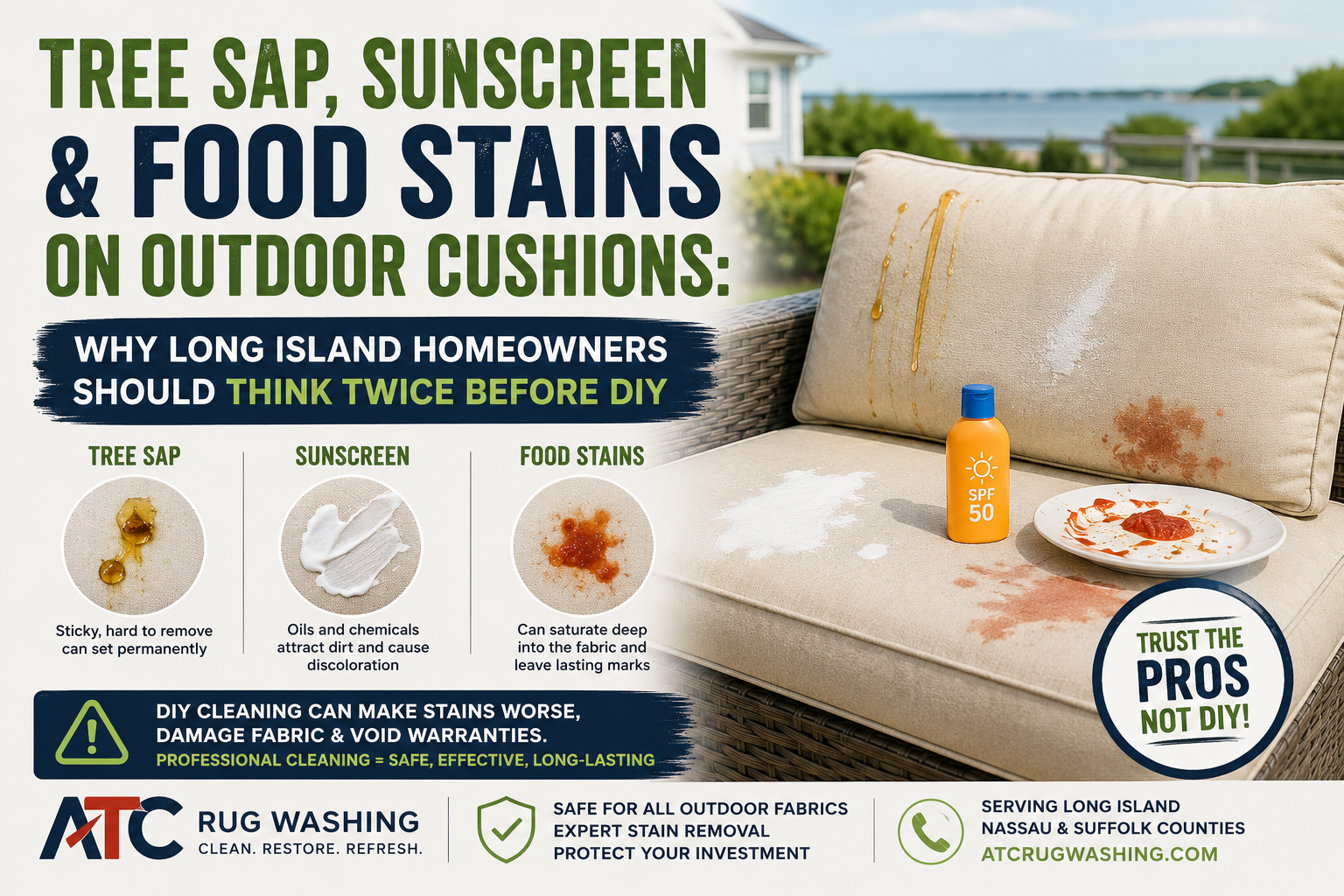
On Long Island, outdoor living is part of everyday life. From backyard barbecues and pool parties to quiet evenings on the deck, your outdoor cushions are where family and friends gather. They also collect everything that comes with that lifestyle: tree sap dripping from maples and oaks, sunscreen and tanning oil from poolside lounging, and food and drink spills from every get‑together.
Long Island’s environment amplifies stain and damage issues on outdoor cushions in ways many people do not realize. Neighborhoods with mature trees expose patios and decks to sap, pollen, and airborne debris that land directly on cushion fabric. Tree sap does not simply sit on the surface; it mixes with fine dust and particles and forms a sticky film that bonds to fibers.
Our strong pool and beach culture means sunscreen, tanning oils, and saltwater are part of normal daily use. These products are engineered to resist water and UV light, so when they transfer onto cushions, they do not simply rinse away. Instead, they migrate deeper into the fibers and cushion core. At the same time, frequent entertaining brings food and drink onto the patio. Burgers, marinades, sauces, wine, soda, coffee, and colorful cocktails all carry dyes, tannins, proteins, and oils that can stain and chemically react with fabric finishes over time.
From the outside, DIY cleaning looks straightforward. You scrub, spray, or “clean” the surface, watch the stain fade while the cushion is wet, and assume the job is done. The most serious damage, however, is not visible until after the cushion dries or sometimes weeks later.
One major issue is the use of harsh chemicals that strip color and weaken fibers. Common household cleaners, degreasers, and bleach‑based products are designed for hard surfaces, kitchen grease, or bathroom grime, not outdoor performance fabrics. When applied to cushions, they can remove color, create permanent fade spots or rings, break down protective finishes that help repel water and soil, and weaken fibers and threads. We regularly see cushions where a single aggressive DIY attempt has shortened the remaining lifespan dramatically, even if the stain looked better for a short time.
Tree sap, sunscreen, and food stains are not ordinary dirt. They are chemically active contaminants that interact with fabrics and finishes over time and require targeted professional treatment.
Tree sap is resin‑based and adhesive by nature. Once it lands on a cushion, it bonds to the fiber surface and traps other contaminants. When homeowners attack sap with generic solvents or scraping tools, they often smear it across a larger area, push it deeper into the weave, or abrade the fabric. In a professional setting, sap removal is treated as a controlled stain‑removal process, not a quick wipe. ATC Rug Washing approaches sap as a specialized contaminant that requires specific chemistry, appropriate dwell time, and measured mechanical action. This minimizes fiber damage and avoids spreading or embedding the resin.
Sunscreen and tanning oils are formulated to stick to skin, resist sweat and water, and survive UV exposure. Those same properties make them extremely difficult to remove from cushions without targeted chemistry and controlled flushing. DIY attempts with heavy degreasers or repeated scrubbing often drive oils deeper and strip color or finishes from the surface. The visible stain may lighten slightly, but a darker shadow remains and the cushion feels different to the touch. In our facility, sunscreen and tanning oils are handled with carefully selected solutions and controlled flushing that reach into the cushion core, removing contamination while preserving fabric integrity.
Food and drink stains combine multiple stain types: oils, proteins, tannins, dyes, sugars, and acids. Every DIY product layered on top interacts differently with each component and with the fabric itself. On Long Island patios, we see greasy barbecue stains, red wine splashes, coffee spills, and brightly colored drink and dessert stains. Each type needs a tailored approach. In a professional cleaning environment, we identify likely stain components, choose suitable solutions and processes, and control temperature, dwell time, mechanical action, and rinsing. That level of control cannot be achieved with a single household cleaner and a garden hose.
Many Long Island homeowners have never seen a professional cushion cleaning process and understandably assume it is simply a more powerful version of what they do at home. In reality, it is a completely different workflow built around fabric safety, thorough contamination removal, and proper drying.
When outdoor cushions arrive at ATC Rug Washing, we begin with a detailed inspection. We check fabric type, construction, seam condition, cushion core composition, and any manufacturer tags or notes. We identify visible stains, subtle shadows, odor issues, and signs of prior DIY attempts. This initial evaluation clarifies not only what is on the cushion, but what has already happened to it.
During cleaning, we use controlled application methods and calibrated equipment. Professional rinse and extraction techniques enable us to remove contamination without over‑wetting or physically stressing seams and fibers. Tree sap, sunscreen, and food stains are treated as individual problems nested within a comprehensive cleaning process, not isolated spots to attack aggressively.
Drying is handled with equal care. Outdoor cushions are dried in a way that promotes even moisture removal and airflow, reducing the risk of internal mildew and distortion. We do not rely on leaving cushions in the sun and hoping for the best. Instead, we control the environment so each cushion returns clean, fresh, and structurally sound.
After drying, we perform a final inspection and, where appropriate, discuss protective options. For certain fabrics, professional protectants can help resist future staining and make ongoing maintenance easier. We only recommend these treatments when they are suitable for the specific upholstery and use case.
Many Long Island homeowners hesitate to invest in professional cushion cleaning because they see it as an optional extra rather than a necessary service. When you compare that cost with the price and hassle of replacing a full cushion set, the picture changes quickly.
Quality outdoor furniture is a significant investment. Cushions for name‑brand or custom sets often cost hundreds or thousands of dollars to replace, especially when upholstery is custom‑matched or part of a coordinated collection. One aggressive DIY attempt with bleach or a power washer can irreversibly damage cushions that would otherwise have provided several more seasons of use.
ATC Rug Washing is known across Long Island for professional rug and textile care, and that same expertise extends to outdoor cushions and patio textiles. Our reputation is built on experience, careful process, and consistent results rather than quick fixes or generic advice.
We understand the specific conditions Long Island cushions face: salt air, humidity, dense tree cover, intense summer use, and seasonal storage challenges. Because we see the full picture across thousands of jobs, we can provide honest, nuanced guidance instead of one‑size‑fits‑all recommendations. Our team treats each cushion as part of your overall environment, whether that is a deck, pool area, patio, or outdoor kitchen. We aim to preserve not just the fabric, but the feel and function of your space.
When ATC Rug Washing advises against a popular DIY method, it is because we have repeatedly seen the damage it causes in real life on real cushions. Our goal is to protect your investment and keep your outdoor living areas comfortable, attractive, and healthy.
Author: Pat Jr., Outdoor Cushion & Textile Cleaning Specialist – ATC Rug Washing (Long Island, NY)
Pat Jr. works hands‑on in professional rug and textile cleaning on Long Island, with a particular focus on outdoor cushions, patio textiles, and high‑value rugs. He oversees stain evaluation, cleaning chemistry, and workflow design at ATC Rug Washing, ensuring each piece is treated with the right combination of method, product, and drying approach.
DIY cushion cleaning often relies on products and methods that are not designed for outdoor fabrics or cushion cores. Harsh chemicals, power washing, and over‑wetting can strip color, weaken fibers, damage seams, and cause internal mildew. In many cases, a single aggressive DIY attempt causes more harm than the original stain and shortens the life of the cushions significantly.
These stains are more serious than they appear at a glance. Tree sap bonds to fibers and traps other contaminants, making removal complex. Sunscreen and tanning oils are formulated to resist water and UV exposure, so they migrate deeper into cushions and do not respond well to casual rinsing. Food and drink stains bring dyes, oils, tannins, sugars, and acids that interact with fabrics over time. Together, they create contamination that is best handled by professional cleaning.
ATC Rug Washing begins with inspection and fabric identification, then designs a cleaning plan specifically for your cushions. We use professional chemistry, controlled application, targeted stain treatments, and managed drying. The process is built around preserving fabric and cushion structure while thoroughly removing contamination, which is very difficult to achieve with home products and basic equipment.
In many cases, we can improve the appearance, feel, and cleanliness of cushions that have already been subjected to DIY methods. However, some types of damage, such as severe color loss, fiber burn, or structural breakdown at seams, may not be fully reversible. The sooner you bring cushions to us after noticing DIY issues, the better the chances of achieving a strong result.
For heavily used patios and pool areas on Long Island, having cushions professionally cleaned once per season is a sensible guideline. At a minimum, a professional cleaning every one to two years helps preserve appearance, cushion life, and indoor‑air quality when cushions are stored. The ideal frequency depends on how often you entertain, your surrounding environment, and how quickly cushions show visible soiling or odor.
We routinely clean a wide range of outdoor cushion fabrics, including many performance textiles from major furniture brands. If you are unsure about your fabric type, we can evaluate it during inspection and explain what is realistic. Our process is designed to respect fabric limitations while achieving meaningful cleaning results.